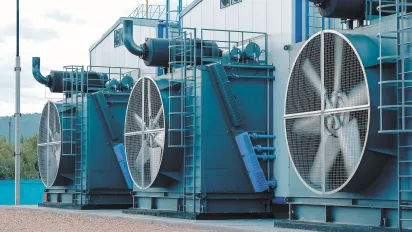
Efficient Monitoring and Control of Blowers and Fans
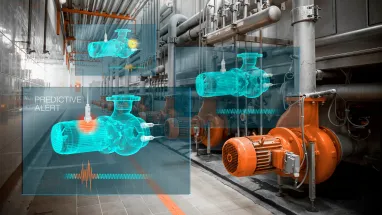
Digital Twin Starter Kit Optimizes Energy Efficiency and Prevents Mechanical Damage
The Application
Blowers and fans are key components in industrial facilities, production plants, and building systems. They ensure air and gas movement, pressure build-up, cooling, or ventilation and are therefore indispensable for the continuous operation of many processes. However, fans and blowers are exposed to high mechanical loads during continuous operation. Imbalances, incorrect rotational speeds, or dirty air ducts can lead to increased vibrations, wear, or damage to bearings and motors. Uneven air flows also impair the efficiency of the systems and increase energy consumption.
The Goal
For reliable and energy-efficient operation, it is crucial to continuously monitor and control the relevant operating parameters. The aim is to detect imbalances or increased vibrations at an early stage in order to prevent mechanical damage and to flexibly adjust the rotational speed and performance of the equipment to actual requirements. At the same time, air flow and pressure should be optimally controlled to reduce energy consumption. In addition, predictive maintenance planning is important for scheduling interventions and increasing plant availability and the service life of components.

The Solution
The Digital Twin Starter Kit from Bosch Business Innovations and Pepperl+Fuchs offers a universal system solution for condition monitoring and efficiency improvement of blowers and fans. Precise sensors, such as 12 kHz vibration sensors from the VIM3 series, measure rotational speed, vibrations, pressure, and temperature directly on the devices. The data is collected using an IO-Link master and transmitted to the Digital Twin Solution via the BTC22 industrial box thin client.
The cloud platform analyzes the information in real time. AI and machine learning algorithms detect imbalances, deviations in air flow, and inefficient operating states. They can also automatically suggest measures for optimization. Optionally, the system can be integrated into existing ERP or building management systems so that servicing and energy optimization processes run seamlessly.
Highlights
- High productivity and efficiency: Ready-to-use plug-and-play solution enables AI-supported analysis and optimization in real time
- Significant resource and cost savings through predictive maintenance strategy
- Precise condition monitoring for asset life extension
- Maximum transparency due to wide range of scenario simulations and early detection of anomalies
- Easy scalability and access via cloud platform guarantee maximum flexibility
- Direct integration into ERP systems for fast, demand-oriented spare parts management

The Advantages
Implementing the Digital Twin Starter Kit enables quick and easy commissioning: Sensor installation, IO-Link master connection, and network connection are completed in just a few steps, and configuration is automated.
After a short teach-in phase, the dashboard continuously provides transparent insights into vibrations, air flow, pressure, energy consumption, and plant status. Early warnings of imbalances enable targeted maintenance planning, avoid unplanned downtime, and extend the service life of the units. At the same time, rotational speed, barometric pressure, and power are optimally controlled, reducing energy consumption and increasing operational efficiency.
At a Glance
- Continuous recording of rotational speed, vibrations, pressure, and temperature
- Early detection of imbalances and mechanical wear
- AI-supported data analysis for optimizing air flow and pressure
- Automated configuration and quick commissioning
- Direct integration into existing production or building management systems
- Reduced energy consumption while increasing plant availability