Select Your Country
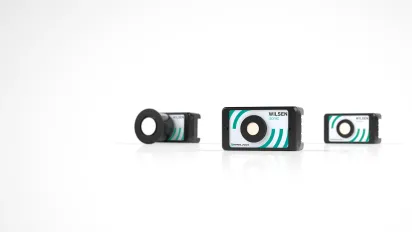
WILSEN.sonic for Intelligent Fill Level and Distance Measurement
Industrial-Quality Wireless IoT Sensors
The WILSEN.sonic sensors are tailored to meet industrial requirements. They reliably detect and transmit levels and distances in demanding environments without needing complex power supply or control system cabling.
Standardized LoRa Technology
By using the worldwide standardized LoRaWAN® network, the WILSEN.sonic sensors transmit their measurement and GPS data energy-efficiently for kilometers.
Easy Installation and Operation
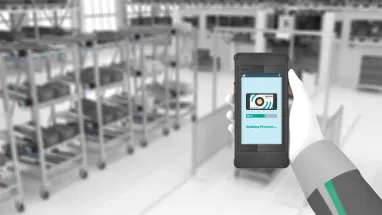
The WILSEN.sonic sensors can be conveniently configured for their intended purpose via downlink channel remote access or directly on site with a mobile device app (Android or iOS).
Maximum Precision and Flexibility
With a resolution of up to 1 mm and a parameterizable sound beam width, WILSEN.sonic sensors can be precisely optimized for any application. Adjustable intervals for event-based monitoring (20 sec to 24 hr) and regular transmission (5 min to 24 hr) allow for even more customized settings and extend battery life.
Smart Cities and Industries
Waste Management
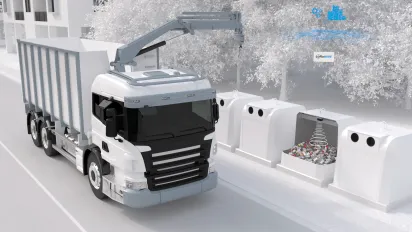
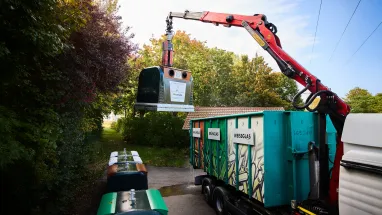
The WILSEN.sonic sensors enable intelligent disposal management, in which the filling levels of used glass, old clothes, and recyclables containers are monitored remotely so that the containers are only collected once filled to a set amount.

The demands placed on cities and municipalities to provide citizens with convenient, environmentally friendly living arrangements are increasing. The WILSEN.sonic sensors enable intelligent disposal management, in which the filling levels of used glass, old clothes, and recyclables containers are monitored remotely so that the containers are only collected once filled to a set amount. This leads to more efficient route planning and thus results in fewer emissions, traffic jams and noise in the urban area.
At the same time, this concept can also be successfully transferred to extensive company premises of manufacturing companies where recycling containers are used on a large scale. The integration of WILSEN.sonic IoT sensors makes it possible to optimize in-house waste disposal processes, thus saving time and money.
Storage Silos
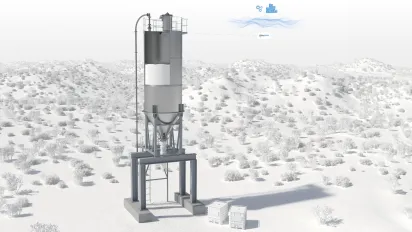
The battery-operated WILSEN.sonic sensors offer both public institutions and industrial companies an efficient solution for gaining insights into a wide variety of containers without the need for complex wiring.

Regardless of whether bulk materials of various kinds or liquids are to be detected: The battery-operated WILSEN.sonic sensors offer both public institutions and industrial companies an efficient solution for gaining insights into a wide variety of containers without the need for complex wiring.
Depending on the type and size of the container, the Pepperl+Fuchs portfolio comprises various WILSEN.sonic variants with different ranges. The WILSEN.sonic version with a detection range of up to 7000 mm offer an ideal solution for larger storage tanks such as the salt silo shown here. Thanks to the high degree of protection (IP66/67), the sensors are also reliably protected at all times against the ingress of liquids or dust particles in the containers.
Intermediate Bulk Containers (IBCs)
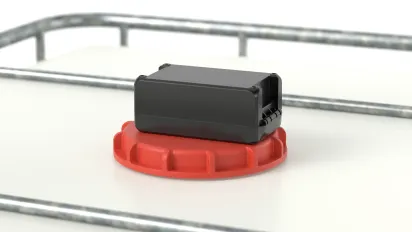
The IBC version of WILSEN.sonic sensors measures the fill level with millimeter precision and transmits the data via LoRaWAN® as a percentage value. The device can be quickly, easily, and securely screwed into any IBC lid with a standard two-inch thread, without the need for cables.
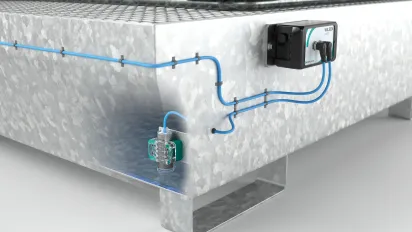
The IBC version of WILSEN.sonic sensors measures the fill level with millimeter precision and transmits the data via LoRaWAN® as a percentage value. The device can be quickly, easily, and securely screwed into any IBC lid with a standard two-inch thread, without the need for cables.
On lids with two screw-in openings, the unused one remains available for supply lines or other attachments. The sensor’s measuring range is preconfigured, so no parameterization is required. When an IBC is replaced, the sensor remains in the lid and can be reused without re-registering it in the LoRaWAN® network. This means only one device is needed per measuring point, regardless of the number of IBCs in use. The sensor also remains intact when an IBC is disposed of.
Additionally adding the WILSEN.sonic's sister device WILSEN.node to the application creates a sophisticated, comprehensive solution for remote monitoring of IBCs. This wireless sensor node enables the detection of leaks or maximum fill levels in collection trays typically used beneath the IBCs.
It allows wireless connection of capacitive sensors or vibration limit switches, both well suited for this detection task. Both types of sensors are also part of Pepperl+Fuchs' comprehensive product portfolio.
Smart Environment
Rainwater Retention Basins
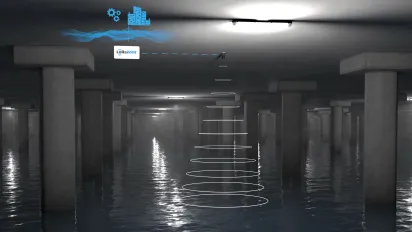
With the help of WILSEN.sonic sensors, the water level in these reservoirs can be monitored even more efficiently: Mounted wirelessly on the ceiling of the retention basin, the sensor is protected against flooding by the water masses thanks to degree of protection IP66/67.

In urban areas sealed by enormous concrete surfaces, underground rainwater retention basins are used to cushion heavy rainfall eventsand prevent flooding. With the help of WILSEN.sonic sensors, the water level in these reservoirs can be monitored even more efficiently: Mounted wirelessly on the ceiling of the retention basin, the sensor is protected against flooding by the water masses thanks to protection class IP66/67. Measured values are then reliably transmitted out of the underground basin. The integrated long-life high-performance battery lasts for years, saving service personnel frequent, time-consuming descents into the basin.
Thanks to its long transmission range, the WILSEN.sonic is also able to transmit fill levels to the nearest LoRa gateway even from remote above-ground rainwater retention basins. The wide temperature range of -25 ... 70 °C guarantees smooth operation of the sensor even in direct sunlight or harsh winter weather.
Smart Farming
Feed Silos
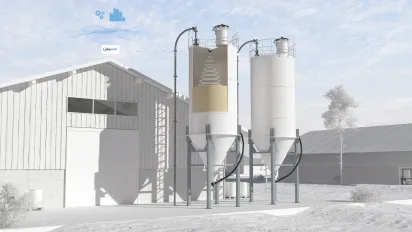
The WILSEN.sonic does not require an external power supply and can be easily mounted in the headspace of silos from where it continuously transmits level data via radio.

To check the fill level of agricultural silos, the outer layer is often tapped with a rubber mallet or a rod and the fill level is determined based on the acoustic resonance. This procedure naturally does not offer the precision of a sensor solution and, in the case of higher silos, also involves the risk of accidents on vertical ladders. However, retrofitting a sensor solution often seems too complicated or error-prone: in addition to the problem of ensuring the power supply to the silo, difficult ambient conditions and possible residues on the sensor make the use of many contactless sensor types almost impossible. Mechanical sensor solutions, on the other hand, are subject to wear and tear on moving parts.
The WILSEN.sonic provides a remedy here: the wireless ultrasonic sensor, which does not require an external power supply, can be easily mounted in the headspace of the silo using the supplied mounting plate, from where it continuously transmits level data via radio. In the unlikely event that dust deposits occur on the sensor's low-adhesion transducer, these usually have no effect on the reliability of the measurement results thanks to the low-interference ultrasonic operating principle. With its wide temperature range of -25 ... 70 °C and degree of protection IP66/67, the sensor can withstand temperature fluctuations in the silo as well as cleaning the inside of the silo with water.
Slurry Pits
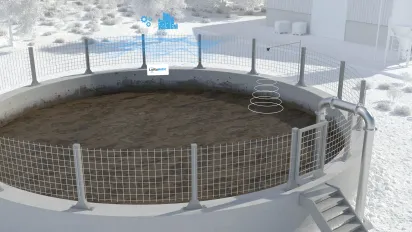
This risk of overflowing slurry pits can be minimized with little effort using WILSEN.sonic sensors. Once a sensor has been mounted on a boom above the slurry pit, it monitors compliance with limit values at all times.

The monitoring and emptying of slurry pits is one of the many tasks on farms. This is usually done on the basis of experience and regular visual inspections. Nonetheless, it cannot be completely ruled out that the task is forgotten for a short time, that an intermediate slide valve does not close properly or that the pit overflows unnoticed due to unexpected heavy rainfall. This results in unplanned work, soil contamination and, in the worst case, even legal consequences due to possible negligence.
This risk can be minimized with little effort using WILSEN.sonic sensors. Once a sensor has been mounted on a boom above the slurry pit, it monitors compliance with limit values at all times. If the limit value is reached, the farmer is notified in time by the downstream IoT platform. The robust design with a PTFE-coated transducer, protection class IP66/67 and a wide temperature range of -25 ... 70 °C, is also suitable for this challenging outdoor application.

Device Overview
| Excerpt from technical data | WS-UCC2500-F406-B41-01-02 | WS-UCC4000-F406-B41-01-02 | WS-UC7000-F406-B41-01-02 | WS-UCC2500-F406-B41-01-02-Y | WS-UCC4000-F406-B41-01-02-Y | WS-UC7000-F406-B41-01-02-Y |
|---|---|---|---|---|---|---|
| Version | WILSEN.sonic.level | WILSEN.sonic.level | WILSEN.sonic.level | WILSEN.sonic.distance | WILSEN.sonic.distance | WILSEN.sonic.distance |
| Sensing principle | Ultrasonic diffuse mode sensor | |||||
| Sensing range | 150 ... 2,500 mm | 250 ... 4,000 mm | 500 ... 7,000 mm | 150 ... 2,500 mm | 250 ... 4,000 mm | 500 ... 7,000 mm |
| Power supply | Replaceable high-power lithium battery, service life up to 10 years 3.6 V, 13,000 mAh | |||||
| Interface | LoRaWAN® | |||||
| Frequency band | EU868 | |||||
| Degree of protection | IP66/67 | |||||
| Temperature range | -25 °C ... +70 °C | |||||
| Technical datasheet | Link | Link | Link | Link | Link | Link |
Knowledge How Does It Work?
LoRaWAN®: IoT Enabling Technology with Numerous Advantages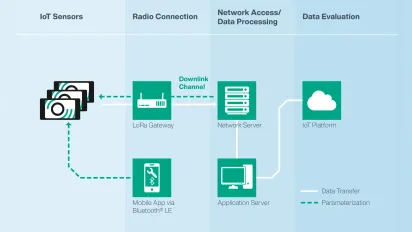
A so-called LoRaWAN® (Long Range Wide Area Network) is required to transfer measured values from the WILSEN IoT sensors to a cloud-based IoT platform and evaluate them there. These easily scalable networks, which are fully geared towards the requirements of the IoT, are characterized by their combination of low energy consumption, long range and secure communication.
In addition to the IoT sensors or other end devices, such a LoRaWAN® architecture usually consists of long-range gateways arranged in a star topology. These gateways translate the data from the WILSEN sensors into an Ethernet-capable protocol and transmit the converted information to a LoRa network server. The network server decodes the sensor data and forwards it to an application server for initial processing before the data can finally be evaluated in an IoT platform.
At the same time, communication in the opposite direction is also possible via the LoRa network server and the gateways: not only can sensor data be received, but parameter settings in the WILSEN sensors can also be conveniently made remotely via the so-called "downlink channel". Pepperl+Fuchs provides a free web service specifically for this purpose.
Alternatively, the sensors can be parameterized directly on site using a mobile device app.
As a member of the LoRa Alliance®, Pepperl+Fuchs is commited to delivering product interoperability and worldwide deployment of this technology.
LoRa technology features a number of advantages that are especially suitable for use with IoT sensors such as Pepperl+Fuchs’ WILSEN:
- Connection of devices up to 15 km away
- Global availability and vendor independence
- Minimal power use during transmission
- Data transfer via radio, no sensor cabling required
- High security and integrity
- Low operating costs
These properties mean that LoRa can be used to create very large wireless networks to implement applications for cities, municipalities and various industries. It can also be used to set up cost-effective private networks on company premises
Videos

Our Partners
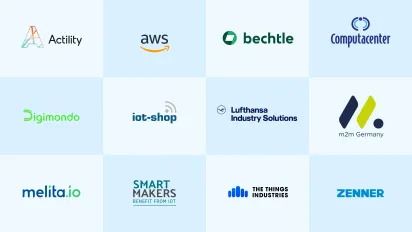
We are optimally networked and can accordingly draw on a broad pool of partners from the LoRa and IoT sectors. Benefit from the combined expertise of Pepperl+Fuchs and these renowned partners when implementing your projects.
Services for Your Success
Ultrasonic sensors from Pepperl+Fuchs are built in our own technology center, where transducer development and manufacturing take place. For more than 30 years, our forward-thinking team of experts has been working continually to advance ultrasonic technology for the solutions of tomorrow. That means our customers always receive the highest performance products on the market.
Support and Tools
We offer not only technical excellence, but also first-class service and support: Our global presence, our deep understanding of different industries and our customer focus set us apart. Of course, this also applies to our portfolio of WILSEN sensors: In this section you will find a selection of tools to help you always get the most out of your sensors and keep operating costs as low as possible.

WILSEN App (iOS and Android)
The WILSEN app for iOS and Android allows you to configure your Pepperl+Fuchs IoT sensors via Bluetooth to match your application. Among other things, you can change sensor settings, check process values, configure the transmission parameters and read diagnostic information on your mobile device.


Downlink Web Service
Once the sensors are integrated into a LoRaWAN® network, parameter settings in the sensor can now be conveniently queried or changed via remote access. With just a few clicks, downlink payloads can be created as hex codes and transmitted directly to the transmit queues of the IoT platforms TTN (The Things Network) and ChirpStack (v3 and v4) via a network API key. If an IoT platform other than TTN or ChirpStack is used, or if no network API key is available, the hex code can also simply be copied and pasted into comparable applications and sent there via downlink.