
The Cyber Resilience Act (CRA)
What Is the Cyber Resilience Act?

With the Cyber Resilience Act (CRA), the European Union is establishing a harmonized regulatory framework for the cybersecurity of products with digital elements. Its aim is to sustainably improve the security of connected hardware and software products and reduce cyber risks throughout the entire product lifecycle.
The regulation primarily applies to manufacturers but also has implications for machine builders, system integrators, and operators of industrial facilities. It establishes binding requirements for the secure development, provision, and maintenance of products, strengthening cyber resilience across the entire value chain.
Taking a Proactive Approach—Building Security and Trust
For Pepperl+Fuchs, the Cyber Resilience Act marks a fundamental shift toward greater security and transparency in industry. We consider its early and consistent implementation an integral part of our responsibility to customers and industrial applications. Through targeted investments in expertise and resources, continuous product assessments, and ongoing improvements to our security processes, we are systematically preparing for the new requirements. Transparent communication and expert guidance help our customers navigate the transition with greater clarity, confidence, and planning security.
Product Evaluation as Part of CRA Conformity Assessment
For each product, Pepperl+Fuchs defines its intended purpose, security context, and support period. This provides customers with clear guidance on appropriate product selection and use, responsibilities for secure installation and operation, and the availability of vulnerability handling and security updates. A published support end date also enables reliable lifecycle planning.

Why Is the CRA Relevant?
Enhanced Product Security from the Start
The Cyber Resilience Act establishes a new, binding foundation for the cybersecurity of products with digital elements. Manufacturers must consider security risks from the earliest stages of development and implement appropriate protective measures throughout the entire product lifecycle. This is intended to reduce common cyber risks, such as inadequately protected interfaces, outdated software, and exploitable security vulnerabilities.
Transparency in Vulnerability Management and Security Updates
A key focus is the continuous management of vulnerabilities. Manufacturers must establish processes to identify, assess, and remediate security vulnerabilities and provide appropriate security updates throughout the designated support period. Customers benefit from greater transparency, improved traceability of security-related changes, and more reliable long-term product maintainability.

Greater Security Across the Supply Chain
Cybersecurity is also becoming increasingly important throughout the industrial supply chain. Machine builders and system integrators must consider the security of the components they use and, where applicable, take relevant compliance documentation into account. Transparent information and clearly defined responsibilities facilitate the integration of secure products into complex industrial applications.
CE Marking and Regulatory Compliance
For products within the scope of the CRA, compliance with the relevant cybersecurity requirements will become part of the conformity assessment process. CE marking indicates conformity with applicable EU requirements, providing an important basis for market access and strengthening confidence in connected industrial technologies.
CRA Reporting Obligations
Pepperl+Fuchs builds on years of experience in vulnerability management and established security processes to meet CRA reporting requirements. Our Computer Emergency Response Team (CERT) handles product security reports and coordinates the necessary response. Our development processes have been certified to IEC 62443-4-1 since 2023, while regularly published security advisories reflect our systematic approach to managing security risks.
Since September 11, 2026, the Cyber Resilience Act requires manufacturers to report actively exploited vulnerabilities and severe security incidents within defined timeframes. An early warning within 24 hours is followed by a more detailed notification within 72 hours and a final report. Reports are submitted via the European Union Agency for Cybersecurity (ENISA) Single Reporting Platform. Our established structures and processes enable us to address these requirements systematically, ensuring transparent communication and reliable handling of security-related incidents.
Timeline and Milestones
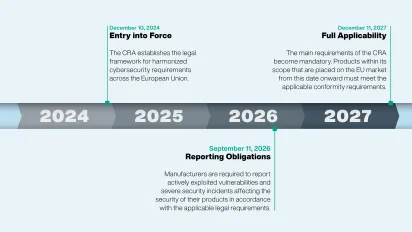
Pepperl+Fuchs is using the transition period to systematically align its products, processes, and documentation with the new requirements and keep customers informed of relevant developments at an early stage.