Inductive Safety Sensors Monitor Boom Extension Mechanism
M12 Non-Flush Sensors Ensure Secured Bolts on Mobile Cranes
The Application
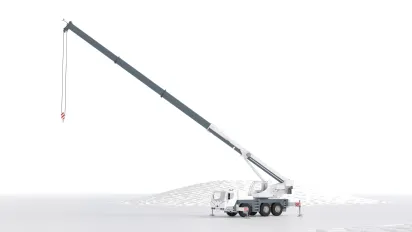
To ensure safe and reliable operation, sensors continuously monitor the position of the bolts within a mobile crane’s extension mechanism. As each telescopic element reaches its full stroke, bolts engage to secure that section of the arm, preventing unintended movement before the next segment extends. A double sliding cylinder moves into the double “diamond” pin, locking and unlocking the boom segment. The entire locking unit is mounted on a lift cylinder, which can shift to multiple positions detected by an internal position measuring system.

The Goal
Ensuring the precise and secure positioning of the bolts within the extension arm is critical to maintaining structural integrity and operational safety. Any deviation in bolt position poses a significant risk and can result in catastrophic mechanical failure of the extension arm. This failure could result in severe equipment damage and hazardous conditions for personnel in the vicinity. Because the bolts are located within the arm’s internal structure, they are not readily visible, making direct inspection challenging. Therefore, it is critical to implement reliable monitoring solutions to verify that all bolts are fully secured throughout the arm’s extension process.

The Solution
Pepperl+Fuchs inductive safety sensors provide an ideal solution for reliably monitoring bolt position within the extension arm. Designed with a high safety rating, the sensor minimizes the risk of incorrect readings, ensuring accurate position detection. The system uses four M12 non-flush inductive sensors; two sensors at the front monitor the locking unit’s status (locked/unlocked), while two additional sensors scan the rear bolt’s position.
Here, a mechanical actuation system controls bolt engagement. As the T-profile extension mechanism moves it shifts an actuating element, driving one mechanism to the right and the other to the left effectively locking a bolt in each direction. In the middle position the actuating element passes beneath the bolt mechanism, triggering the “open” sensor. When the mechanism moves laterally to lock the bolt sideways, the “closed” sensor is activated, confirming a secured position.
Technical Features
- High process safety: SIL 2/PL d rating
- High process safety: SIL 3/PL e rating with redundant implementation
- Short circuit and overload protection
- IP68/IP69 degree of protection
- Extended operating temperature (–40 °C to +85 °C)
- Output type: OSSD for direct connection to safety PLCs
- Threaded stainless housings
The Benefits
M12 non-flush inductive safety sensors offer significant advantages over competitor safety sensors, especially in applications requiring precise position monitoring. Unlike other fail-safe inductive sensors, Pepperl+Fuchs sensors do not require a specialized target; any metal can be used. Also, these sensors have no “dead band” directly in front of the sensing face, eliminating blind spots. These features simplify installation. The sensors can be mounted easily without the need for mechanical adjustments or installing a specialized target.
At a Glance
- Reliable detection without dead band: data transfer can occur with no minimum distance
- Can be used in redundant configurations to achieve higher safety levels such as SIL 3/PL e
- Non-contact sensing: provides wear-free operation, increasing lifetime and reducing maintenance