Ambient Conditions
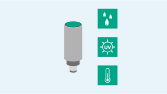
Particularities of ambient conditions must be considered so that sensors can meet the requirements placed on them. For special ambient condition requirements, in most cases there are suitable sensor versions that can be used effectively.
Ambient Temperature
The permissible ambient temperature is the temperature range in which an inductive sensor functions properly. The following applies to standard sensors from Pepperl+Fuchs:
- Ambient temperature: -25 °C ... +70 °C or 248 K … 343 K
- Storage temperature: -40 °C ... +85 °C or 233 K … 358 K
For special shapes:
-25 °C ... +100 °C or 248 K ... 373 K
-40 °C ... +150 °C or 233 K ... 423 K
0 °C ... +200 °C or 273 K ... 473 K
0 °C ... +250 °C or 273 K ... 523 K
Shock Resistance and Vibration Resistance
Capacitive sensors are subjected to comprehensive testing for their shock resistance and vibration resistance requirements. Shock resistance testing is carried out in accordance with IEC 60068-2-27. Vibration resistance testing is carried out in accordance with IEC 60068-2-6.
Degrees of Protection
Depending on the requirements, capacitive sensors are protected according to IP65, IP67, or IP68 (EN 60529). Versions with degree of protection IP69K are available for use in particularly harsh industrial environments.
Products with IPX8 degree of protection from Pepperl+Fuchs meet the following conditions:
- 1 m water column above the test sample
- 24 h operation under water with cyclical damping and undamping under nominal load
- Cycle time 2 h
- Water temperature = room temperature +5 °C