2025/9/5LoRaWAN® WILSEN.node Wireless Sensor Node: Easy Retrofit with Volt-Free Contacts

Pepperl+Fuchs is adding another useful feature to its LoRaWAN®-based wireless sensor node, WILSEN.node. Previously, inductive sensors, capacitive sensors, float switches, and similar components could be connected to the central unit. Now, up to two volt-free contacts, such as relays or toggle switches, can be connected in addition. This expansion will make it easy and flexible to perform tasks in the field that previously would have required extensive cabling and high costs.


Simplified Wiring with Complete Cable Solution
Volt-free contacts are connected via an adapter cable with integrated resistor network, which is available from stock and can be extended by up to 10 meters. This cable is connected on one side to the battery-powered central unit of the WILSEN.node and on the other side to the volt-free contact, such as a relay or a simple toggle switch. The resistor network also enables lead breakage detection from the WILSEN.node to the end of the adapter cable.
Alternatively, the cabling can also be routed through the wall of an existing housing to the volt-free contact and terminated with a flange plug featuring an open cable end, which is also available.
Kilometer-Wide Data Transmission over Many Years
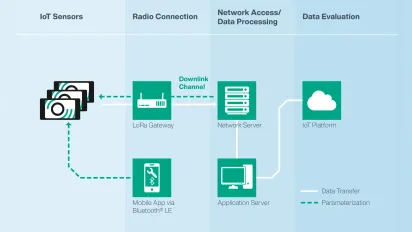
Once the up to two volt-free contacts have been successfully connected to the central unit, a status change is checked at least once a minute. If the switching status changes, a data packet with the relevant information is transmitted wirelessly to the IoT platform via a LoRaWAN® network. The globally standardized LoRaWAN technology used here is characterized by its high energy efficiency and long-range signal transmission, enabling volt-free contacts located kilometers away to be integrated into IoT infrastructures with minimal cabling.

Highlights of the WILSEN.node Wireless Sensor Node
- Maximum flexibility through connection of various sensor technologies or volt-free contacts
- Reliable monitoring of retrofit scenarios and lead breakages
- Rugged wireless sensors, ready for use in harsh environments
- Globally standardized LoRaWAN network for efficient, long-range signal transmission
- Maintenance-free runtimes of several years due to high-performance lithium battery with 13,000 mAh